
Loans
How to Lower Your Mortgage Payment: 7 Options Compared
Refinancing, dropping PMI, recasting, appealing property taxes and shopping insurance can all lower a mortgage payment. See worked examples and the tradeoffs of each.
By Muhammad Bashir, founder of TotalMonthlyPublished · 5 min read

Your monthly mortgage payment usually has four or five parts: principal, interest, property tax, homeowners insurance and sometimes mortgage insurance. Each part can be reduced in a different way. Some options cost nothing and some cost thousands, so it pays to start with the cheap ones.
1. Remove mortgage insurance
If you put less than 20% down on a conventional loan, you probably pay private mortgage insurance. You can ask your servicer to cancel it once your balance reaches 80% of the home’s original value, and it ends automatically at 78%. If your home has gained value, a new appraisal may let you cancel sooner, depending on your servicer’s rules.
In our PMI guide example, PMI on a $380,000 loan costs about $285 a month. Removing it lowers the payment by that amount at no cost beyond a possible appraisal fee.
FHA mortgage insurance follows different rules and often lasts for the life of the loan. Many FHA borrowers remove it by refinancing into a conventional loan once they have about 20% equity.
2. Refinance to a lower rate
Refinancing replaces your loan with a new one, ideally at a lower rate. It has closing costs, so it makes sense only if you keep the new loan long enough to recover them.
Worked example: a $300,000 balance at 7.5% with 28 years left costs about $2,138.60 a month in principal and interest. Refinancing into a new 30-year loan at 6.25% costs about $1,847.15, which is $291.45 less each month. With $6,000 in closing costs, you would recover the cost in about 21 months.
This example also restarts the clock at 30 years, which adds two years of payments. The refinance calculator shows the break-even point and the total interest of both loans. Read should you refinance before you apply.
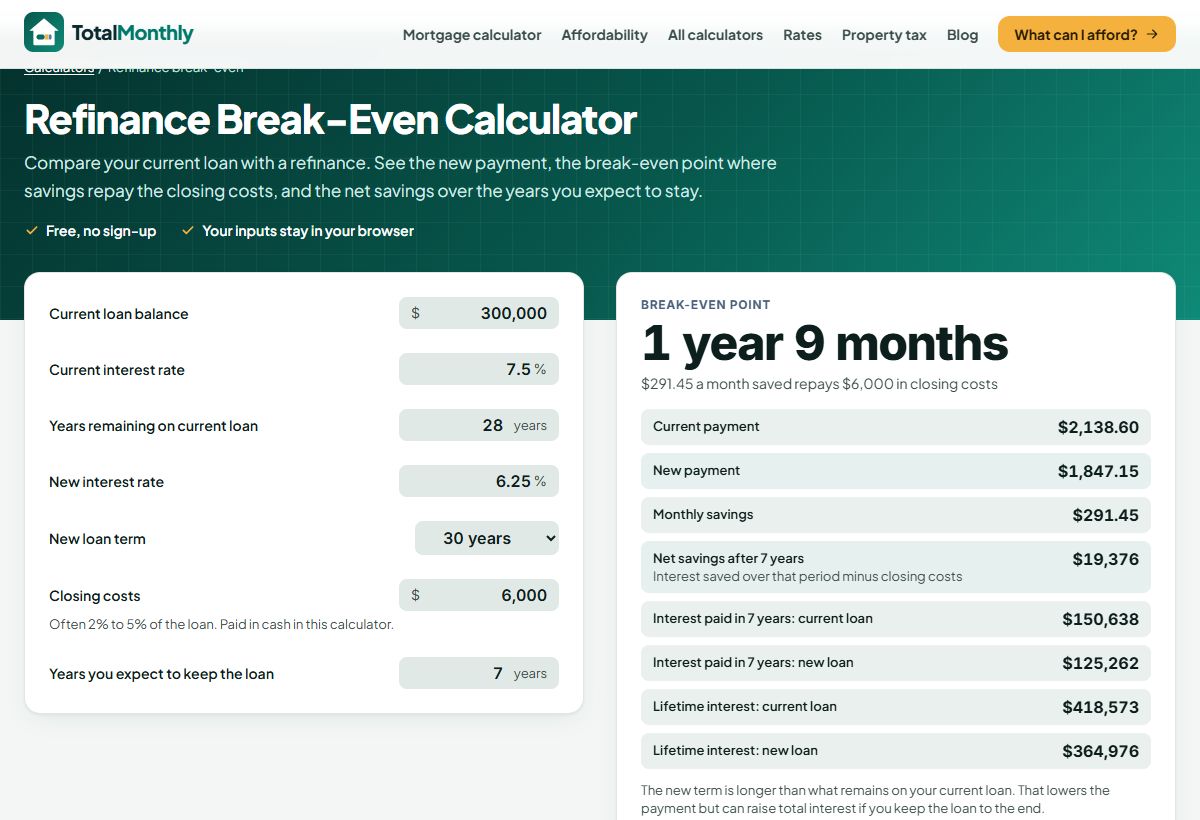
The refinance example in the refinance calculator.
3. Recast the loan
A recast, also called reamortization, means paying a lump sum toward principal and asking the servicer to recalculate your payment over the remaining term. The rate and the payoff date stay the same. Servicers that offer it usually charge a modest fee and set a minimum lump sum. Government-backed loans such as FHA and VA often cannot be recast.
Worked example: a $300,000 balance at 6.5% with 27 years left costs about $1,966.66 a month. Paying $25,000 and recasting lowers it to about $1,802.78, which is $163.89 less a month, with no new loan and no credit check.
A recast is useful if you have cash from selling a previous home or from an inheritance and your rate is already good.
4. Appeal your property tax assessment
Property tax is based on your home’s assessed value. If the assessment is higher than what similar homes are worth, you can usually appeal it with your county assessor. Check the record for errors first, such as the wrong square footage or number of bathrooms. Also ask about exemptions, such as a homestead exemption for a primary residence, which many states offer.
Lower taxes reduce your escrow payment once your servicer runs its next escrow analysis. See property taxes when you buy a home and your state on our property tax by state page.
5. Shop your homeowners insurance
Insurance prices change, and your current insurer may not be the cheapest any more. Compare quotes for the same coverage, ask about bundling with auto insurance, and consider a higher deductible if you have savings to cover it. Tell your servicer about the new policy so it can update your escrow. Do not cut coverage below what your lender requires or what it would cost to rebuild.
6. Ask about a loan modification
If you are struggling to pay because of a hardship, such as a job loss or illness, your servicer may be able to change the loan’s terms. A modification can lower the rate, extend the term or add missed payments to the balance. Call your servicer as early as possible, and consider talking to a free HUD-approved housing counselor at 800-569-4287. Read can you skip a mortgage payment for the options when you cannot pay.
7. Extend the term
Refinancing a 15-year loan into a 30-year loan, or restarting a 30-year loan, lowers the monthly payment because you repay the balance over more months. The tradeoff is much more total interest. It can be a reasonable safety valve, and you can still pay extra later when money allows.
Which option to try first
| Option | Typical cost | Changes your rate? |
|---|---|---|
| Remove PMI | Appraisal fee, if any | No |
| Appeal property tax | Usually free | No |
| Shop insurance | Free | No |
| Recast | Lump sum plus a fee | No |
| Refinance | Closing costs | Yes |
| Modification | Usually free, hardship required | Sometimes |
| Extend the term | Closing costs | Usually |
Start with the free options. Then compare a recast and a refinance using your real numbers in the mortgage calculator.
Common questions
Will making extra payments lower my monthly payment?
Not on most loans. Extra payments shorten the loan and save interest, but the scheduled payment stays the same unless you recast. See biweekly mortgage payments.
Why did my payment go up when my rate is fixed?
Usually because property taxes or insurance rose, which increases the escrow part of your payment. Check your annual escrow statement to see which part changed.
Key takeaways
- Free options come first: removing PMI, appealing taxes and shopping insurance.
- A recast lowers the payment without a new loan if you have a lump sum.
- Refinance only if you will keep the loan past the break-even point.
For education, not financial or legal advice. Rules, rates and fees change; confirm with a lender or licensed professional. See our methodology and disclaimer.
Keep reading
All guides
Loans
PMI vs MIP: Conventional and FHA Mortgage Insurance Compared
PMI and MIP both protect the lender, but they cost and end differently. See a worked comparison on a $400,000 home and how your credit score changes the answer.

Loans
VA vs FHA vs Conventional Loans: Which Costs Less?
Compare VA, FHA and conventional loans on down payment, mortgage insurance, upfront fees and monthly cost, with a worked example on a $400,000 home.

Loans
Biweekly Mortgage Payments: How Much Do They Really Save?
Paying half your mortgage every two weeks adds one extra monthly payment a year. See a worked example, how servicers apply it, and a simpler way to get the same savings.