
Loans
Biweekly Mortgage Payments: How Much Do They Really Save?
Paying half your mortgage every two weeks adds one extra monthly payment a year. See a worked example, how servicers apply it, and a simpler way to get the same savings.
By Muhammad Bashir, founder of TotalMonthlyPublished · 4 min read
A biweekly plan means paying half of your monthly mortgage payment every two weeks instead of the full payment once a month. It sounds like the same amount of money, but it is not. A year has 52 weeks, so you make 26 half payments, which add up to 13 full payments instead of 12. That one extra payment a year goes to principal, and it shortens the loan.
Why it works
Every dollar of extra payment reduces your loan balance directly. A smaller balance means less interest next month, so a larger share of each regular payment goes to principal after that. The effect compounds over the years. A biweekly plan just automates one extra payment a year.
A worked example
Take a $320,000 loan at 6.5% for 30 years. The monthly principal and interest payment is about $2,022.62.
- Paying monthly: 360 payments, about $408,142 in total interest.
- Paying biweekly: 26 payments of about $1,011.31 a year, which is one extra payment of $2,022.62 a year. The loan is paid off in about 24 years and 2 months, with about $315,069 in total interest.
That is about $93,000 less interest and almost six years sooner, for the price of roughly $169 a month in extra principal. These figures cover principal and interest only and assume the rate stays fixed. Taxes and insurance in escrow do not change.
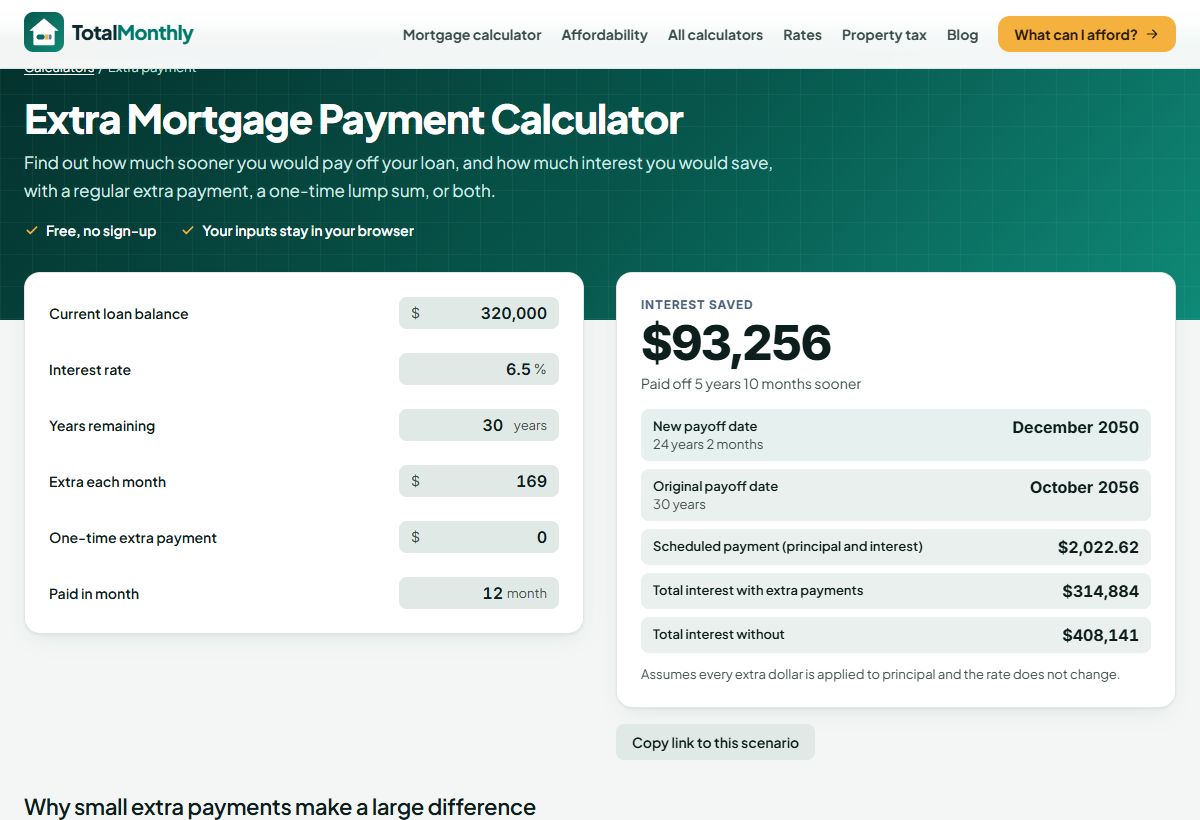
The example in the extra payment calculator, with one twelfth of the payment added each month.
How your servicer may apply the money
- Some servicers accept biweekly payments directly and apply each half payment when it arrives. Ask how and when they credit it.
- Many servicers hold a half payment until the second half arrives, then apply a full monthly payment. You still get the extra payment each year, but your interest savings come from that extra payment, not from paying every two weeks.
- Some servicers return or reject partial payments. Sending half payments without arranging it first can even look like a late payment.
Call your servicer before you start. Ask whether they offer a biweekly option, whether it has a fee, and how extra money is applied. Make sure extra amounts go to principal, not to next month’s payment.
Watch out for third-party plans
Companies sometimes offer to manage biweekly payments for you, for an enrollment fee or a charge on every payment. They usually collect your money every two weeks but send it to your servicer once a month, and they make the extra payment once a year. You can do the same thing yourself for free.
A simpler way to get the same result
You do not need a biweekly schedule to get these savings. Divide your monthly principal and interest payment by 12 and add that amount to every monthly payment as extra principal. In the example, that is about $169 a month. The result is nearly identical, about $93,000 saved and the same payoff date of about 24 years and 2 months. It also works with any servicer and is easy to stop if money gets tight.
Other ways to make the same extra payment:
- One extra payment a year, for example from a tax refund or bonus.
- Rounding up each payment to the next $100.
Try your own loan in the extra payment calculator, which shows the new payoff date and the interest you save.
When biweekly payments may not be the best use of money
Extra mortgage payments lower your interest cost at your mortgage rate. Before you commit, check that:
- You have an emergency fund. Money paid into your home is hard to get back without selling or borrowing.
- You have no higher-interest debt. Paying off a credit card at 20% or more saves far more than prepaying a mortgage at 6.5%.
- You are getting any employer retirement match. Skipping a match leaves free money on the table.
- Your loan has no prepayment penalty. Most loans today do not, but check your note or Loan Estimate.
Common questions
Does a biweekly plan lower my monthly payment?
No. It shortens the loan and cuts total interest, but each scheduled payment stays the same. If you want a lower monthly payment instead, see how to lower your mortgage payment.
Is biweekly the same as paying twice a month?
No. Paying twice a month gives 24 half payments a year, which equals 12 full payments and saves almost nothing. Biweekly gives 26 half payments, and those two extra halves are the whole benefit.
Can I start biweekly payments on an existing loan?
Usually yes, if your servicer supports it. The savings are largest when you start early in the loan, because that is when the balance and the interest are highest.
Key takeaways
- Biweekly payments add one extra monthly payment a year, which goes to principal.
- On a $320,000 loan at 6.5%, that saves about $93,000 and nearly six years.
- Adding one twelfth of your payment each month gets the same result with no special setup or fees.
For education, not financial or legal advice. Rules, rates and fees change; confirm with a lender or licensed professional. See our methodology and disclaimer.
Keep reading
All guides
Loans
PMI vs MIP: Conventional and FHA Mortgage Insurance Compared
PMI and MIP both protect the lender, but they cost and end differently. See a worked comparison on a $400,000 home and how your credit score changes the answer.
Loans
VA vs FHA vs Conventional Loans: Which Costs Less?
Compare VA, FHA and conventional loans on down payment, mortgage insurance, upfront fees and monthly cost, with a worked example on a $400,000 home.

Loans
Can You Skip a Mortgage Payment? Options If You Can't Pay
Missing a mortgage payment without an agreement brings late fees and credit damage. Learn what happens and the forbearance, deferral and modification options.